Free guide

Business plans:
14 things to know before you submit

A checklist built from comments actually written in grant, competition and IR reviews

  • 29-page PDF, with a reviewer comment and a one-line summary for each section
  • Written in November 2026 by Taeeun Kim after 700+ mentoring sessions and 100+ reviews
  • Ends with five workshops on your own plan and a 12-question self-check

Each PDF gets a download number in its footer, one per person. Your name and email are not included

The PDF is in Korean

You may share it as is with credit. Changing, re-editing or commercial use is not allowed (CC BY-NC-ND 4.0)

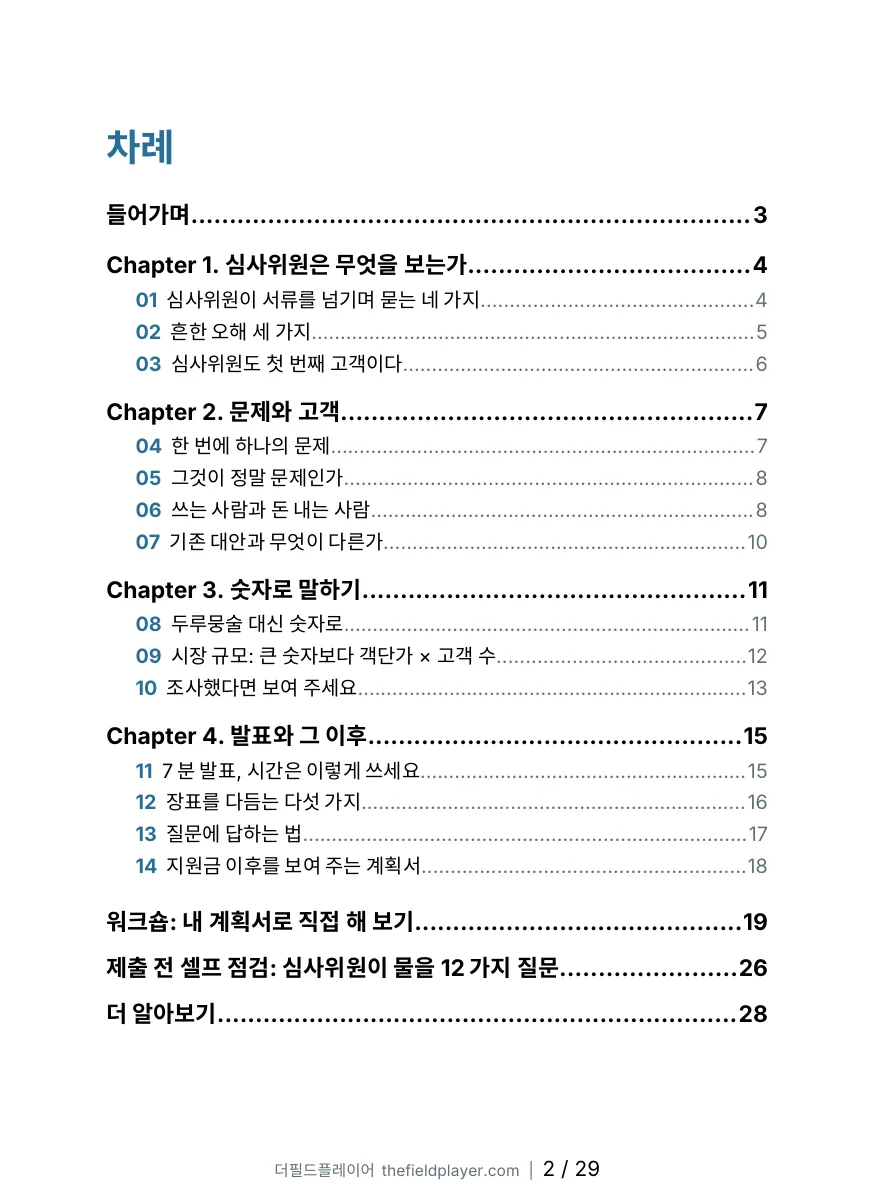
14 things in one line each

See what to look at first

Why it matters and how to fix it continue in the PDF with reviewer comments and figures

Chapter 1

What reviewers look at

  1. 01Four questions reviewers ask while flipping pagesPreviewReviewers look at a sense of reality, the problem found, the ability to deliver, and the track so far
  2. 02Three common misunderstandingsLooking nice, a fancy title and a polite manner don't change scores. Content and evidence do
  3. 03Reviewers are your first customers tooReviewers may not be experts in your field. Show simply whose problem you solve and who pays

Chapter 2

Problem and customer

  1. 04One problem at a timeOne problem, one solution, one message. Leave the rest for later stages
  2. 05Is it really a problem?The problem you are sure of may differ from the one customers have. Meeting just 6 to 12 people gives you evidence
  3. 06The user and the payerAnswer "So who buys this?" Connect the user's pain to the payer's reason to buy
  4. 07How it differs from existing optionsShow the current way, the remaining problem, then your way. Competitors mean there is a market

Chapter 3

Speak in numbers

  1. 08Numbers instead of vague wordsResults must be recordable in numbers. Without sales yet, set stage goals with proxy indicators
  2. 09Market size: price per customer × customers, not a big numberPreviewShow price per customer and number of customers, not a big market figure. The path from the first market to wider ones is the key
  3. 10If you researched, show itResearch results and first sales are the strongest evidence. Don't hide them, visualize them

Chapter 4

The pitch and after

  1. 11A 7-minute pitch: how to use the timeFor 7 minutes: problem 30 seconds, solution 2 to 3 minutes, market 1 to 2 minutes, team 30 seconds. Spend the most on the solution
  2. 12Five ways to polish slidesOne claim per slide, everyday words, no slide numbers, a useful last slide, evidence in the appendix
  3. 13How to answer questionsDon't change your answer with every question. Questions mean "fill this in and I'll believe you"
  4. 14A plan that shows life after the grantShow it can continue after support ends. The answer is the market's response, not reviewers' praise
Book preview

You can turn the pages

See chapters 01 and 09 exactly as they appear in the PDF

The PDF is in Korean

Page 1
Page 2
1~2 / 29
Preview | Chapter 1

01Four questions reviewers ask while flipping pages

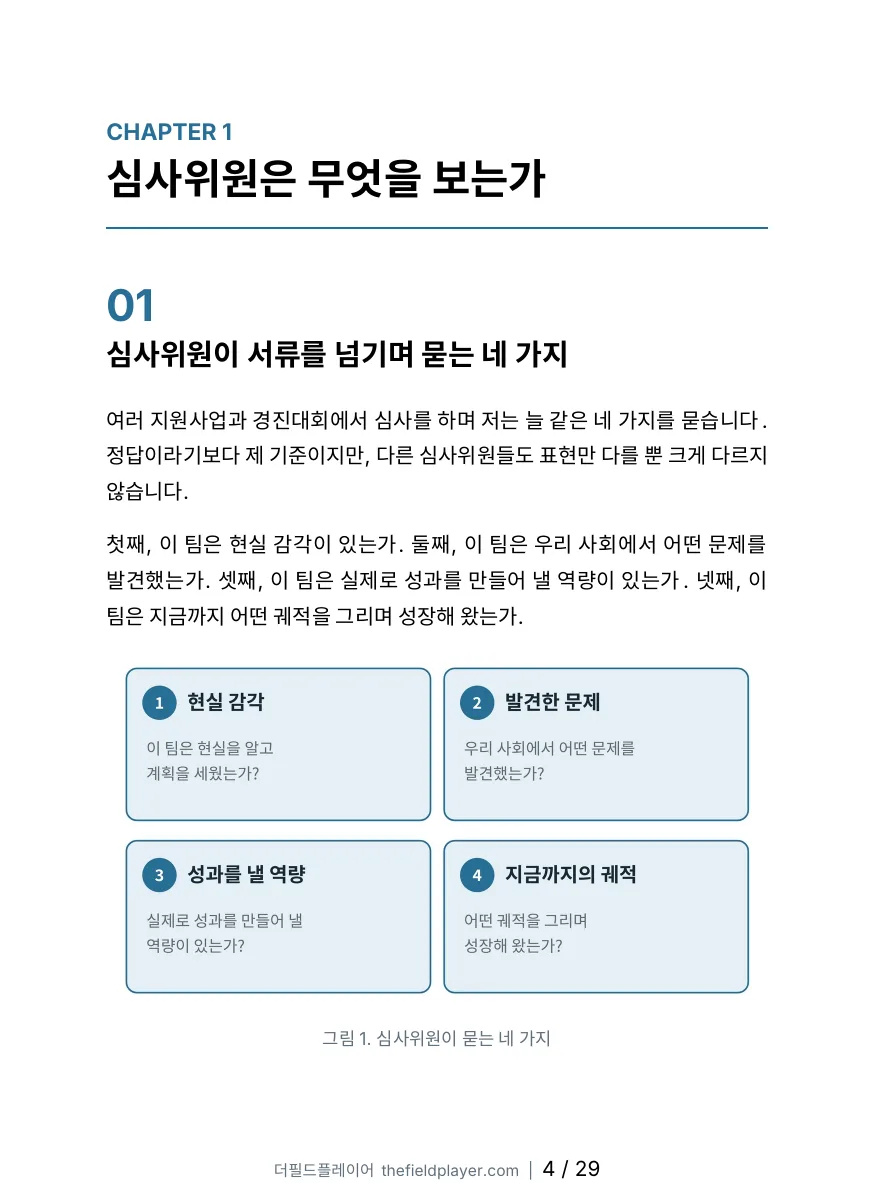
Reviewing for many grant programs and competitions, I always ask the same four questions. They are my own standard rather than the right answer, but other reviewers ask much the same in different words.

First, does this team have a sense of reality? Second, what problem has this team found in our society? Third, does this team have the ability to actually deliver results? Fourth, what track has this team followed as it grew?

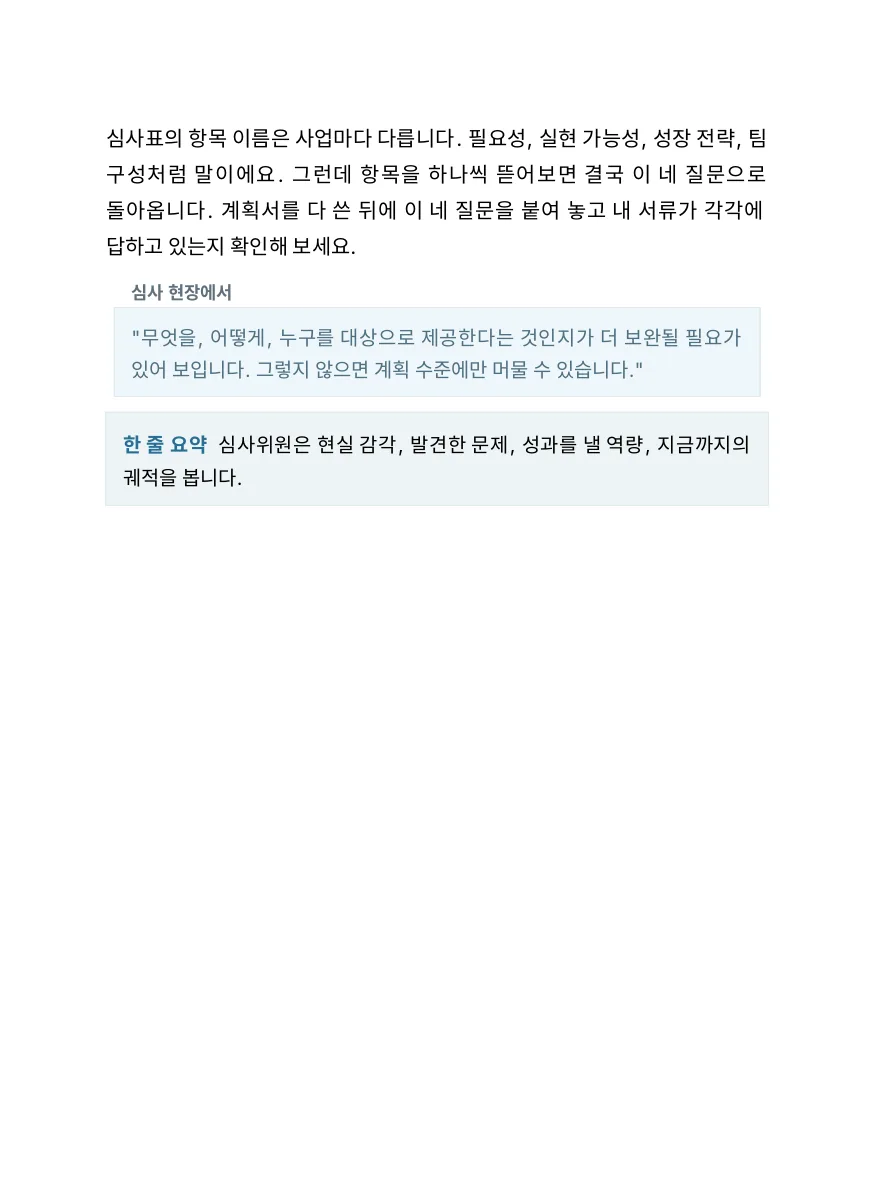
Review criteria are named differently in each program, such as need, feasibility, growth strategy and team. Yet if you break each item down, they come back to these four questions. When your plan is done, put these four questions next to it and check whether your document answers each one.

Figure 1. Four questions reviewers ask

From the review room“What you will offer, how, and to whom needs more work. Otherwise it may stay at the level of a plan.”

In one lineReviewers look at a sense of reality, the problem found, the ability to deliver, and the track so far

Preview | Chapter 3

09Market size: price per customer × customers, not a big number

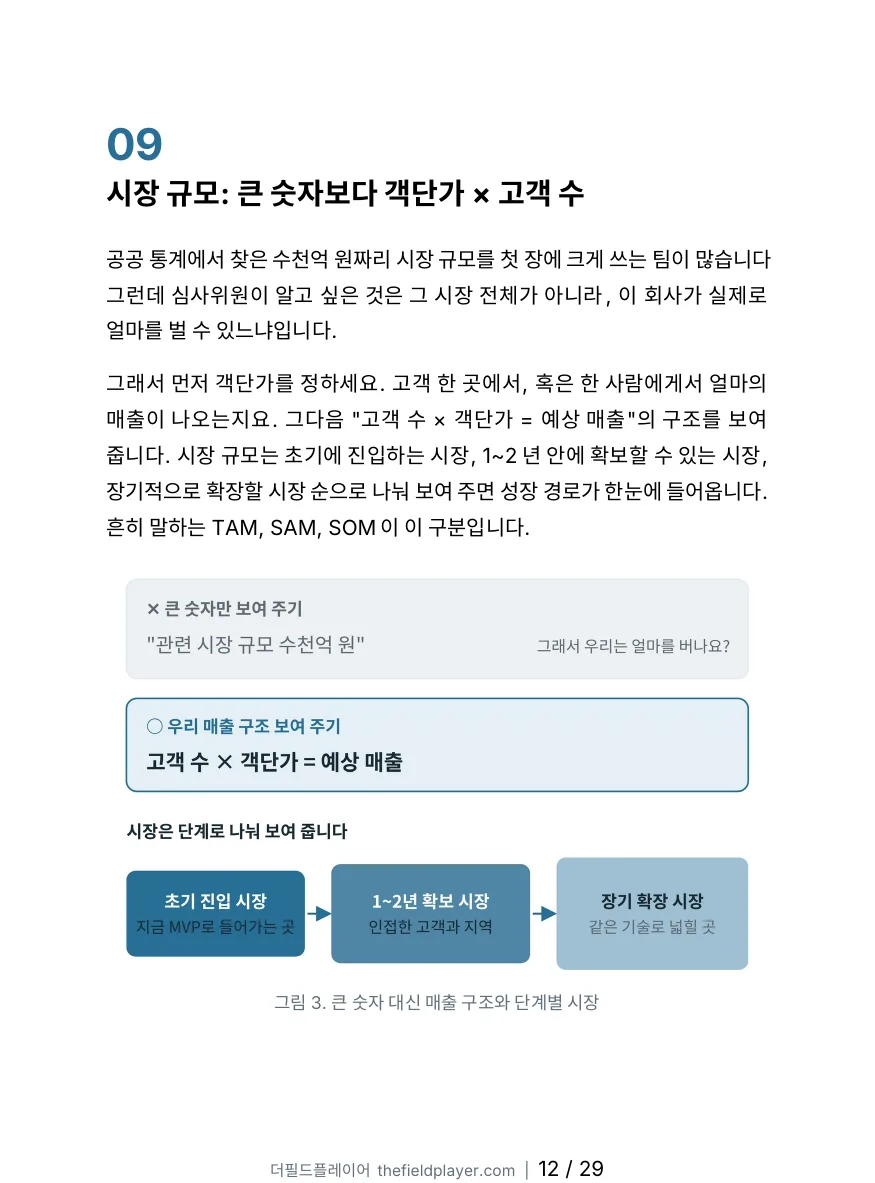
Many teams put a market size of hundreds of billions of won from public statistics in big letters on the first slide. But reviewers want to know how much this company can actually earn, not the size of the whole market.

So set your price per customer first: how much revenue comes from one client or one person. Then show the structure "customers × price per customer = expected revenue". Split the market into the market you enter first, the market you can win in 1 to 2 years, and the market you expand to in the long run, and your growth path becomes clear at a glance. This is what TAM, SAM and SOM mean.

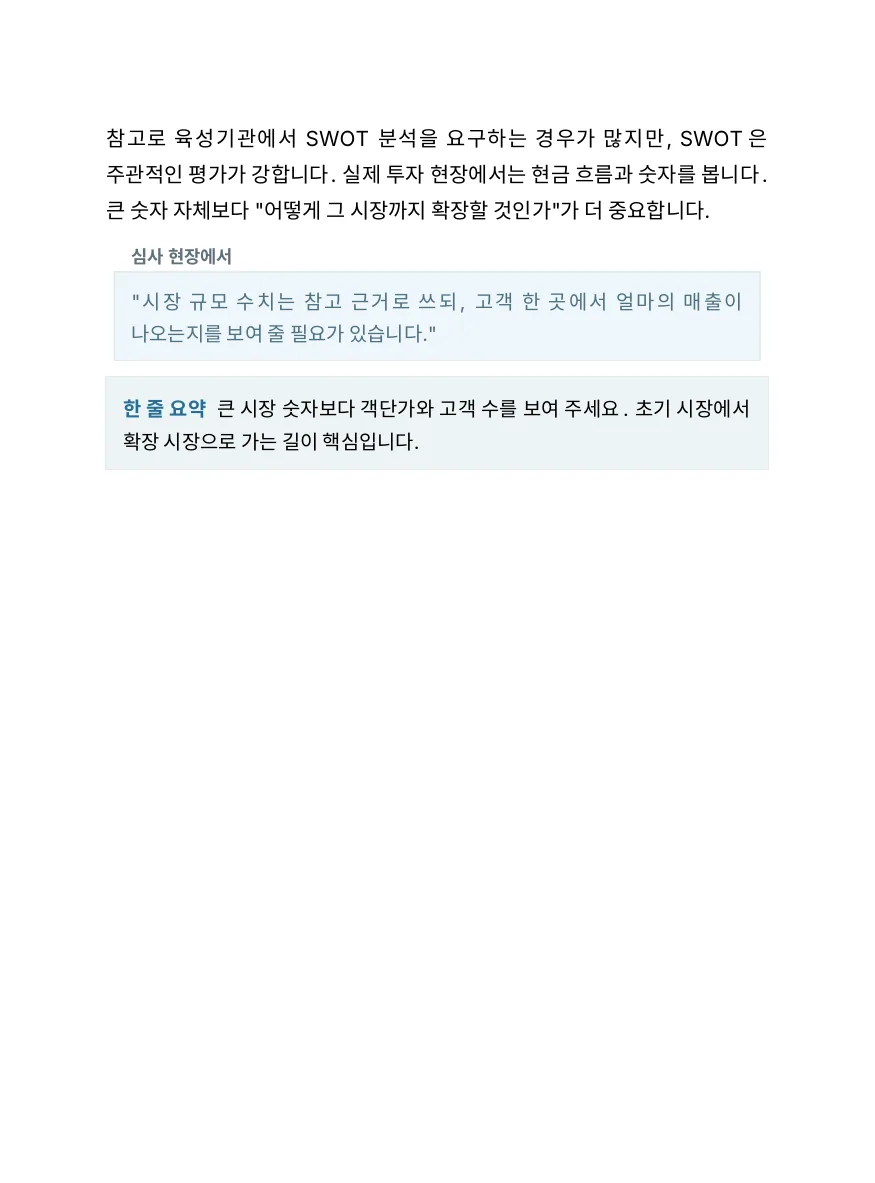
Incubators often ask for a SWOT analysis, but SWOT is highly subjective. In real investment settings, people look at cash flow and numbers. How you will grow into that market matters more than the big number itself.

Figure 3. Revenue structure and market stages instead of a big number

From the review room“Use market size figures as reference, but you need to show how much revenue one client brings.”

In one lineShow price per customer and number of customers, not a big market figure. The path from the first market to wider ones is the key

Still stuck after filling it in?

Ask PARANAVI® M about the stuck part right away. Look at it through a reviewer's eyes and set one thing to do this week

Log in to PARANAVI® M